
Key Points
**DISCOVERY — Signal** Postgraduate students are surrounded by an abundance of knowledge yet remain intellectually isolated, struggling to distinguish what matters, locate defensible gaps, and connect theory to their inquiry. The signal is therefore not a shortage of knowledge, but a failure to convert knowledge into judgment.
**LEARNING — Why It Matters** If postgraduate education is meant to produce independent researchers, students must learn not merely what is known, but how to question, reason, judge, and create knowledge for themselves. The Socratic approach makes this transition possible by turning uncertainty into disciplined inquiry.
**INNOVATION — Opportunity** This creates an opportunity to rethink supervision itself: the Professor-Led Research Apprenticeship can transform the professor from a provider of answers into an architect of epistemic independence. Its ultimate measure is simple — the professor succeeds when the student no longer needs the professor to think.

Why do postgraduate researchers—surrounded by knowledge, supervisors, and literature—experience the production of knowledge as a field of one?
The Peculiar Loneliness No One Talks About
There is a peculiar loneliness at the heart of postgraduate research. A student may have a supervisor, a university, a strong research proposal, and access to an abundance of knowledge, yet experience the production of knowledge as a field of one. The difficulty is commonly located in the student—insufficient preparation, weak conceptualization, poor writing—or in the supervisor—insufficient guidance, delayed feedback, excessive workload. And as recent research reveals (Forrester, 2025; Hysing, M., Petrie, K. J., Harvey, A. G., & Sivertsen, B., 2026), loneliness among university students leads to depression occasioned by harsh feedback and unreasonable expectations from supervisors and their institutions.
However, such accounts may describe the experience without necessarily explaining the conditions that generate it. This study therefore asks a different question: what must be the case for a system designed to produce independent researchers to repeatedly generate experiences of intellectual dependence, uncertainty, and isolation? Adopting Critical Realism, the study problematizes assumptions embedded in prevailing problematic approaches to postgraduate supervision and proposes an alternative conceptualization: a professor-led research apprenticeship system grounded in the Socratic approach.
Listening to 172 Postgraduates: From What They Feel to What Must Be True
The study combined empirical inquiry with critical realist explanation. Following Danermark et al. (2002), the research moved from empirical observation through conceptual abstraction and abduction toward retroduction: from what students experience to what happens in supervision and ultimately to what structures and mechanisms could generate these experiences. A qualitative survey of 172 postgraduate students from a large South African university was used to expose students’ experiences of undertaking research, with particular attention to the intellectual work involved in developing literature reviews and theoretical frameworks.
The open-ended responses were analyzed inductively using thematic analysis in the manner advocated by Braun and Clarke (2006). The resulting empirical account was then interpreted through Pawson and Tilley’s (1997) Context–Mechanism–Outcome (CMO) logic. This does not treat CMO as a successionist causal model; rather, it provides a realist heuristic for asking what occurs, through which mechanisms, for whom, and under what conditions.
Such contextualization is important because, as Nielsen et al. (2022) demonstrate, context in realist inquiry is not merely background but part of the explanation of how mechanisms become activated. The analysis therefore connects students’ experienced difficulties to the wider epistemic, relational, and institutional conditions within which postgraduate research is lived.
The Paradox That Breaks Most Students: Too Much and Too Little at Once
The students’ accounts reveal a striking paradox of abundance and scarcity. That paradox is not one problem. It is three.
Relevance Filtering: When You Can’t Tell What Matters
Some students experienced an overwhelming volume of literature and limited time to synthesize it, while others encountered too little directly relevant literature, particularly where they claimed their topics were novel. The difficulty was therefore not simply access to information but relevance filtering and contextual translation: students struggled to determine which literature mattered, how it related to their own inquiry, and where a defensible research gap could be located. Temporal currency added another layer of difficulty, with recent literature becoming a gatekeeper of relevance.
The Gap as a Threshold: From Summary to Critique
Gap identification emerged as a threshold concept: students could summarize literature yet struggle to move from summary to critique. They could describe what others had said but not yet interrupt that conversation. The gap was therefore not a missing paragraph to be found but a judgement to be made—about what is known, what is contested, and where one’s own inquiry becomes necessary. Yet the data also reveal conditions under which difficulty became productive. Clearly defined scaffolding reduced uncertainty, while structured engagement helped students clarify research gaps and refine research questions. When scaffolding was explicit, the gap moved from being a source of anxiety to a source of agency.
Theoretical Abundance, Theoretical Void
Similar tensions appeared in theoretical framework development, where theoretical abundance produced decision paralysis, uncertainty about fit and alignment, difficulty representing frameworks diagrammatically, and, for claimed novel topics, an apparent theoretical void. For some, there were too many theories and no clear criteria for choice. For others claiming novelty, there appeared to be no theory at all. In both cases, the real difficulty was not absence or abundance, but alignment: how does this theory help me see what I could not see before, and how will I know if it fits?
Read through CMO reasoning; these findings suggest that postgraduate research difficulties are not simply deficits residing within students; they emerge through the interaction between complex knowledge environments, insufficiently explicit epistemic scaffolding, and the student’s developing capacity to reason across literature, theory, and the research problem.
Surrounded by Knowledge, Epistemically Alone: The Contradiction in How We Supervise
The abductive–retroductive synthesis points toward a deeper contradiction in conventional postgraduate supervision: postgraduate education requires students to become independent producers of knowledge, while the supervisory relationship may leave much of the reasoning required to achieve that independence tacit, fragmented, or externally authorized. The student can therefore be surrounded by knowledge while remaining epistemically alone. The question becomes not simply how to provide more supervision, but what kind of supervisory mechanisms can convert the abundance of knowledge into the student’s capacity for independent judgment?
Here the Socratic approach emerges as an abductively plausible and retroductively derived proposition. Its potential lies not in questioning for its own sake, but in activating a mechanism of disciplined reasoning: questions expose assumptions; dialogue makes tacit reasoning explicit; challenge creates the need for justification; and repeated inquiry progressively transfers the work of judgment from supervisor to researcher. In this sense, the Socratic approach resonates with Bhaskar’s conception of explanatory critique and emancipation, in which explanation is connected to the possibility of transforming conditions that constrain human agency.
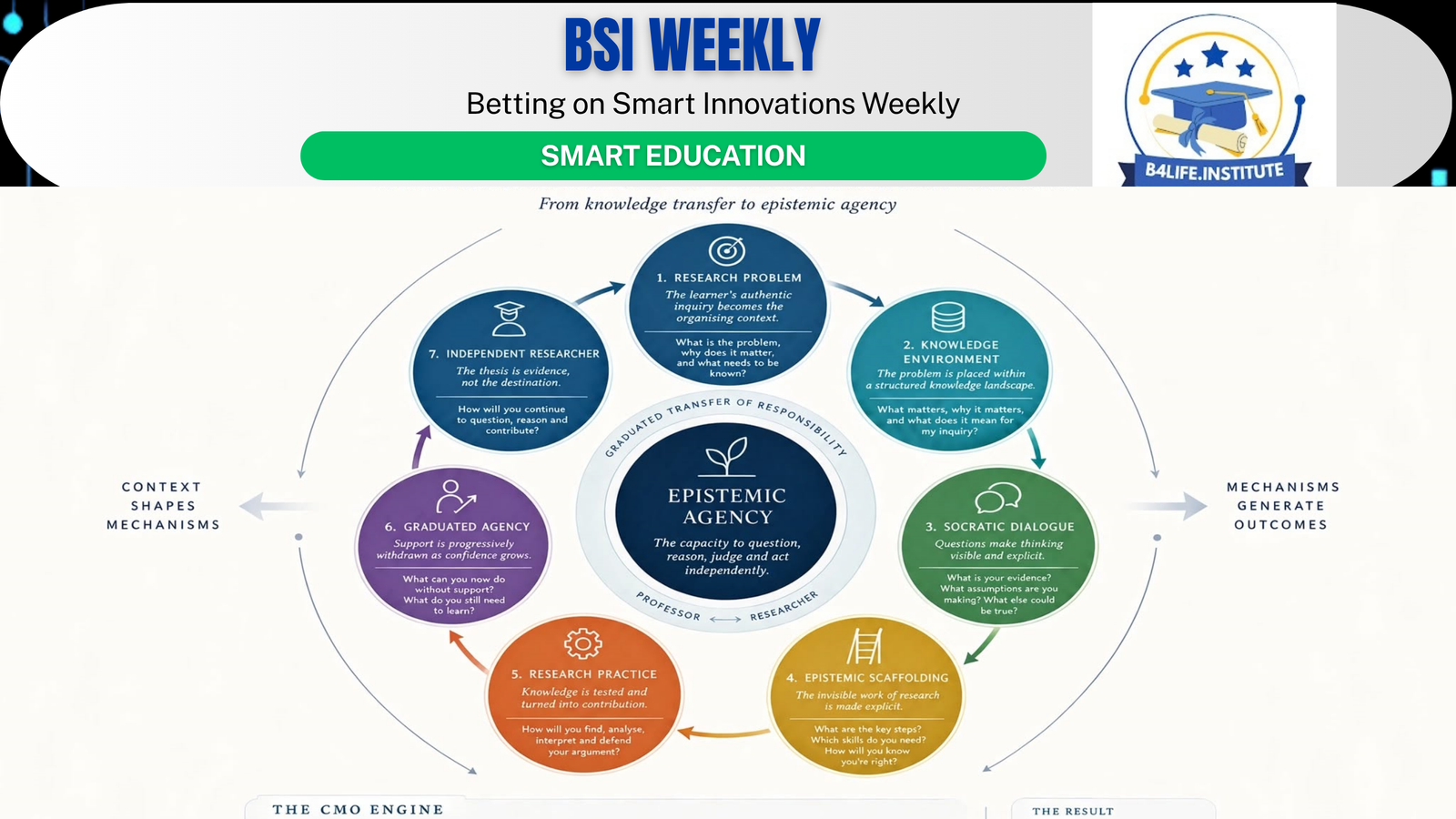
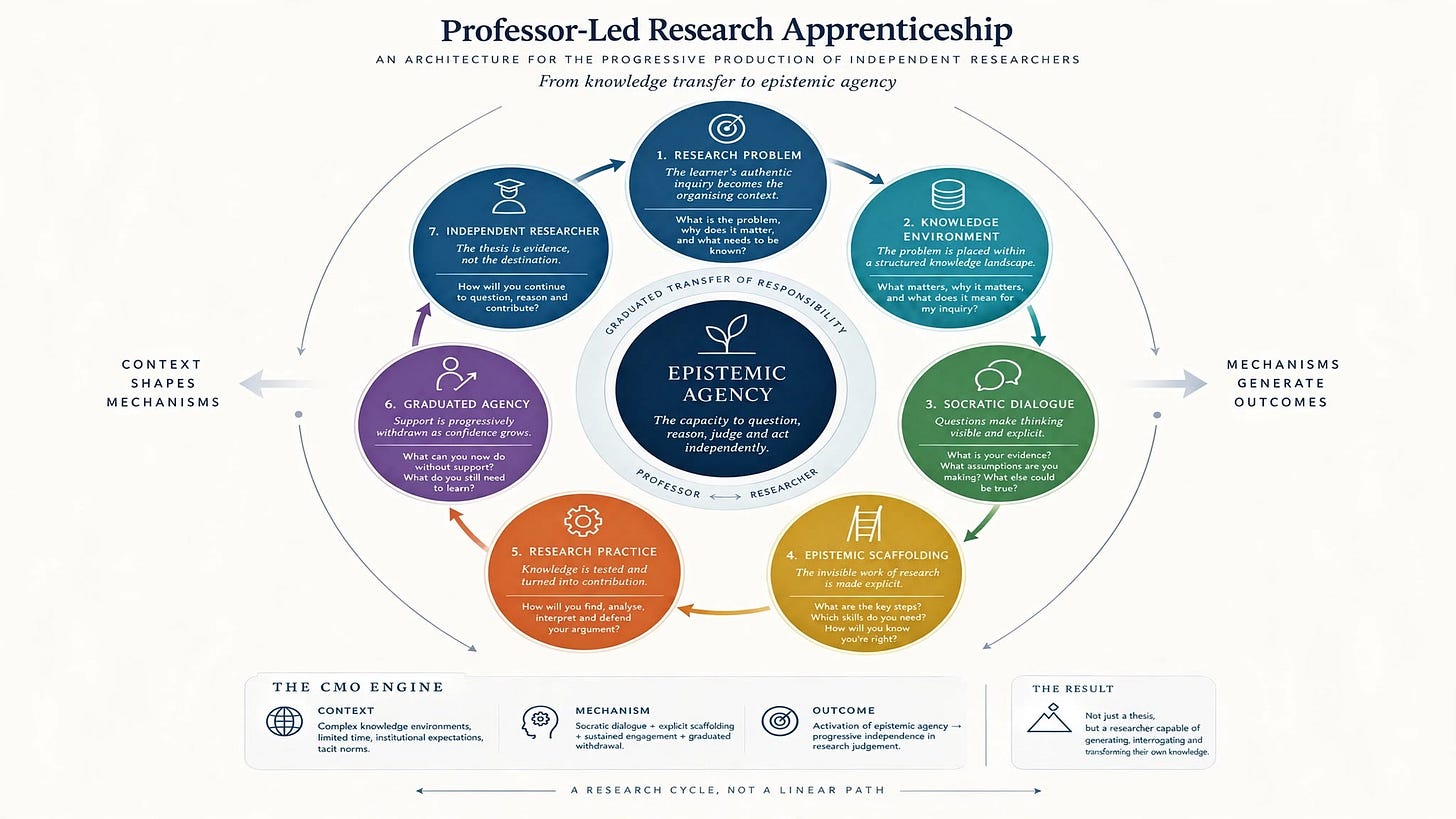
The proposition advanced is therefore a Professor-Led Research Apprenticeship (PRA) in which the professor does not primarily transmit solutions but creates a structured intellectual environment in which the student learns to generate, interrogate, and defend them.
The Professor’s Success Is Measured by Becoming Unnecessary
The study proposes that the central outcome of postgraduate supervision should not be the production of a compliant thesis but the emergence of a researcher capable of interrogating and transforming their own thinking. The Professor-Led Research Apprenticeship is proposed as a practical CMO configuration. In this context, postgraduate researchers are exposed to complex knowledge tasks while receiving sustained Socratic dialogue and graduated scaffolding from a professor.
This environment activates the mechanism of epistemic agency. Consequently, researchers develop a greater capacity to identify literature gaps, align theory with inquiry, and progressively transition into independent scholars. This is a proposition for empirical testing, not a claim of demonstrated effectiveness. Its emancipatory promise lies in a deceptively simple reversal of conventional supervision: the professor’s success is therefore not measured by how indispensable the professor becomes, but by whether the student progressively acquires the capacity to question, reason, judge, and act without surrendering that capacity to another.
Where to start
The Professor-Led Research Apprenticeship is now live at B4Life.Institute. Week 1 begins with a diagnostic session that produces a documented research map—an honest account of where the researcher’s work actually stands. If you are a postgraduate researcher, a supervisor, or an institution that wants to run this program, start here.
Explore the Smart Education field →
Sources
Alvesson, M., & Sandberg, J. (2011). Generating research questions through problematization. Academy of Management Review, 36(2), 247–271.
Bhaskar, R. (2002). Meta-Reality: Creativity, love and freedom. SAGE Publications.
Bhaskar, R. (2009). Scientific realism and human emancipation. Routledge. (Original work published 1986.)
Braun, V., & Clarke, V. (2006). Using thematic analysis in psychology. Qualitative Research in Psychology, 3(2), 77–101.
Danermark, B., Ekstrom, M., Jakobsen, L., & Karlsson, J. C. (2002). Explaining society: Critical realism in the social sciences. Routledge.
Forrester, N. (2025). Harsh criticism and unreasonable expectations worsen PhD students' mental health. Nature.
Hysing, M., Petrie, K. J., Harvey, A. G., & Sivertsen, B. (2026). From loneliness to depression: A longitudinal diagnostic study among Norwegian university students. Social Psychiatry and Psychiatric Epidemiology, 61(3), 449–459.
Nielsen, S. B., Lemire, S., & Tangsig, S. (2022). Unpacking context in realist evaluations: Findings from a comprehensive review. Evaluation, 28(1), 91–112.
Pawson, R., & Tilley, N. (1997). Realistic evaluation. SAGE Publications.
Ochara, N. M. (2026). Pain in a Field of One: Can the Socratic Approach Yield Relief in Postgraduate Research?. BSI Weekly: Smart Education, 1(1). https://b4life.substack.com/p/pain-in-a-field-of-one-can-the-socratic
Available at: https://b4life.substack.com/p/pain-in-a-field-of-one-can-the-socratic